

How do I get players to interact with the environment instead of rolling constantly?

There’s a familiar moment in modern RPGs when the party enters a suspicious room. The GM describes a cracked stone altar, faded murals, a cold draft, and a pile of bones near the eastern wall. A player immediately says, “I roll Perception.” Another joins in. “Investigation.” Soon everyone is staring at dice, and the room has stopped being a place. It has become a difficulty class.
There’s nothing wrong with perception-style skills. They solve a real problem: characters may notice things their players would not. But when every interaction with the environment becomes “I roll to search,” something useful gets lost. Older styles of dungeon exploration often approached the problem from the other direction. Instead of asking whether the character successfully searched the room, the GM asked what the character actually did. That tiny shift can completely change exploration.
The Room Is Not a Skill Check
Imagine the characters find a heavy oak desk in an abandoned wizard’s study. In a roll-first game, a player might say, “I search the desk,” make a check, and receive whatever information the result permits.
With descriptive exploration, the conversation continues. “I open the drawers.” The GM tells them the top two contain brittle letters, while the bottom drawer sticks halfway. The player pulls harder. It still doesn’t move, so they take the other drawers out and look behind them. Now they discover a narrow iron catch hidden inside the frame.
No brilliant deduction was required. No pixel-hunting. The player simply treated the desk like an actual object. That was one of the strengths of older exploration procedures: the fictional environment functioned as something the players could interrogate directly. Doors could be listened at. Floors could be tapped. Statues could be rotated. Pools could be stirred with ten-foot poles, spear shafts, or whichever unfortunate henchman had drawn the short straw. The point was not that players were expected to guess the GM’s secret password. The point was that exploration itself was gameplay.

Why It Worked
Descriptive exploration gives players something rolls cannot provide quite as easily: agency over method. “I search the room” tells the GM the desired outcome. “I run my fingers beneath the edge of the table, then check whether any floorboards are loose” tells the GM how the character is trying to achieve it.
That distinction matters because methods create consequences. A character pressing every brick in a corridor might find the concealed door, but also trigger the pressure plate. Someone listening at a tomb might hear whispering inside without opening it. A player pouring water onto a dusty floor may reveal footprints leading straight through a supposedly solid wall. These moments feel satisfying because the players caused the discovery through interaction rather than simply requesting information from the rules.
They also give the GM more interesting decisions. Instead of judging only whether a roll succeeds, the GM can respond to what the players actually attempt. The fiction starts producing the consequences, not just the number on the die.
Why We Drifted Away From It
There are good reasons modern games often lean harder on skills. Skill systems give characters mechanical identities. If someone invested heavily in perception, investigation, survival, lore, or similar abilities, that investment should matter. Rolls also prevent games from becoming tests of whether the player happens to phrase a search exactly the way the GM imagined.
Nobody wants this exchange: “You didn’t say you looked under the rug.” “I said I searched the room.” “Yes, but technically...” At that point the dungeon should probably collapse out of embarrassment.
Descriptive exploration becomes unpleasant when it turns into semantic trap-setting. The GM knows where everything is; the players do not. Requiring impossibly precise declarations just rewards mind-reading. The useful older principle is not “never roll.” It is: let fictional interaction happen before the roll replaces it.
Dice Should Answer Uncertainty, Not Prevent Interaction
A good compromise is simple. If the players describe an action that would obviously reveal something, give them the information. If they move the bookshelf, they find the door behind it. If they examine the underside of the idol and the inscription is there, they see it. If they pour wine into the carved basin and the liquid drains through tiny channels forming a map, the map appears. No check is necessary because there is no meaningful uncertainty.
Roll when uncertainty actually remains. A character hurriedly searching a cluttered chamber while goblins approach may need a check. Someone trying to spot a nearly invisible tripwire in dim torchlight probably does too. A scholar deciphering weathered inscriptions might rely on knowledge, training, or luck. The dice become more interesting because they are resolving situations rather than substituting for situations.
Telegraph Danger, Then Let Players Experiment
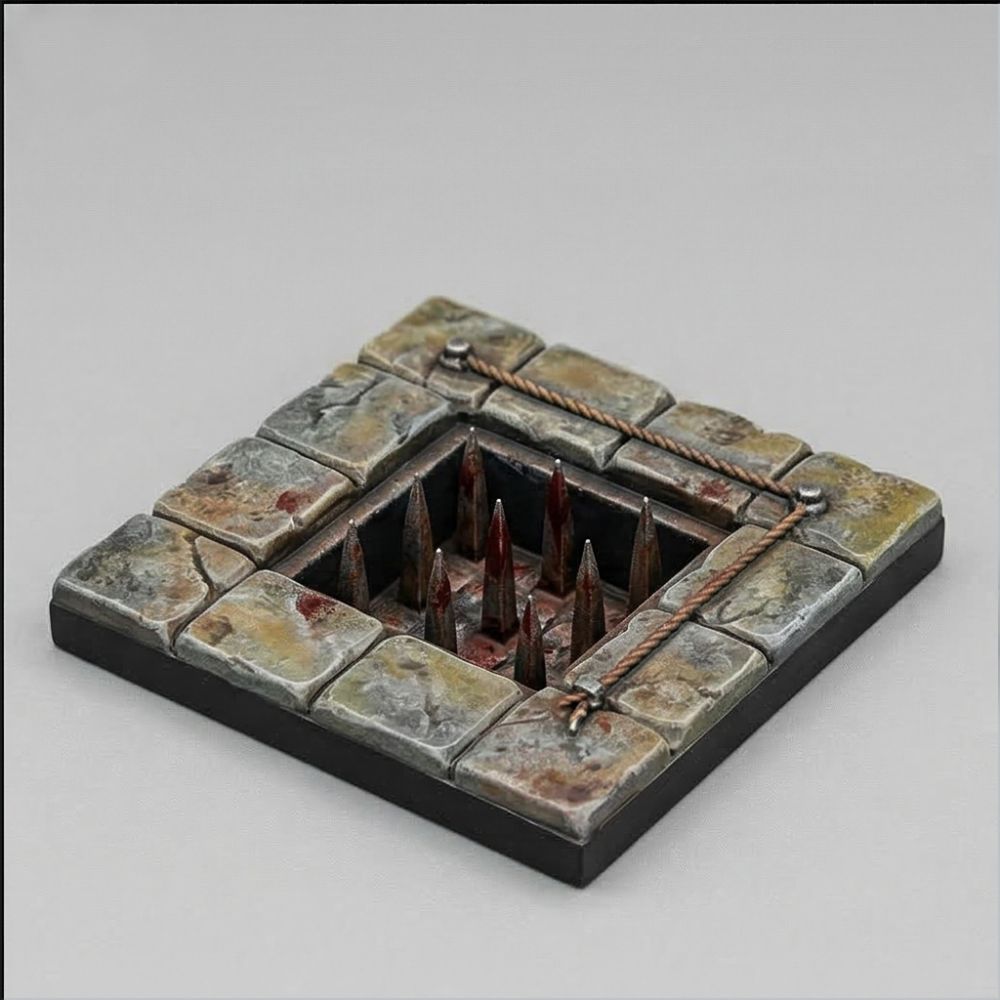
Descriptive exploration works best when the environment provides clues. Suppose a corridor contains a lethal pressure plate. Simply asking, “Where exactly do you step?” and killing someone for choosing incorrectly is not particularly engaging. Instead, give the corridor evidence: one flagstone is unusually clean, a skeleton lies ahead with both legs shattered, and scrape marks run vertically along the walls.
Now the players have something to investigate. They might throw a stone onto the clean tile, slide a shield across it, examine the skeleton, or hammer iron spikes between the suspicious slab and its neighbor. Maybe they still make a roll somewhere in that process. But now the roll exists inside a chain of decisions. That is the real goal: not removing mechanics, but creating conversations with the fictional world.
Monsters and NPCs Can Be Explored Too
This idea extends beyond secret doors. Players can investigate creatures through observation. A troll recoils when the alchemist uncorks a certain bottle. The stone guardian never crosses the mosaic border. The ghost answers questions about everyone except the murdered duke. Those are all pieces of information the players can act on without needing the GM to turn every discovery into a passive check.
NPCs work the same way. Instead of immediately asking for Insight, players might watch who the nervous merchant looks toward when questioned. They might deliberately mention a rival faction and observe the reaction. They might notice that the priest speaks confidently about the temple but becomes evasive whenever anyone mentions the crypt. A social skill roll can still matter, but players now have evidence to reason from. The game becomes less about pushing the correct character-sheet button and more about discovering how the world behaves.
7 Ways to Bring Descriptive Exploration Back
Put obvious interaction points in rooms. Chains, levers, cracked statues, extinguished braziers, unusual drafts, stained floors, loose stones, strange echoes.
Reward specific actions with specific information. If someone opens the corpse’s clenched fist, tell them what is inside rather than requesting a generic search roll.
Let equipment matter. Mirrors, chalk, rope, poles, flour, bells, candles, buckets, crowbars, and mundane tools become surprisingly entertaining when environments react logically.
Telegraph dangerous features. Scorch marks, broken arrows, dead vermin, strange smells, chipped stone, and nervous hirelings give players something to investigate before disaster strikes.
Ask one follow-up question. When someone says, “I search the altar,” respond with, “Sure, what are you checking first?” Often that is enough to start real interaction.
Allow good plans to bypass rolls. If the players invent a method that removes the uncertainty, let it work. Clever preparation is already a form of success.
Hide discoveries behind curiosity, not vocabulary. Players should not need to say the magical sentence you secretly wrote in your notes. Reward genuine engagement with the situation.
Make the World Touchable Again
Perception checks are useful. Investigation skills are useful. Character abilities should absolutely matter. But those mechanics become richer when they support exploration instead of replacing it.
A dungeon room should not merely contain information waiting to be unlocked by a successful roll. It can be a physical puzzle box full of surfaces, sounds, mechanisms, clues, risks, and opportunities. The next time someone says, “I roll to search the room,” you do not need to ban the roll. Just ask one question first: “What do you do?”